
Hearing about famous people with ADHD can be a transformative experience for young people who often feel “broken” or “different.” Instead of focusing solely on the frustrations of a busy brain, these stories provide a mirror that reflects potential rather than just pathology.
When a young person sees someone they admire succeeding, it shifts the internal narrative from “I can’t do this” to “I process things differently, and that’s okay.”
Success for successful people with ADHD isn’t limited to one path; it thrives across sports, acting, music, business, and tireless activism. While the internet is full of speculation, this blog focuses on famous ADHD people who have openly shared their diagnoses to help dismantle the stigma.
Famous people with ADHD in sport, film, and music
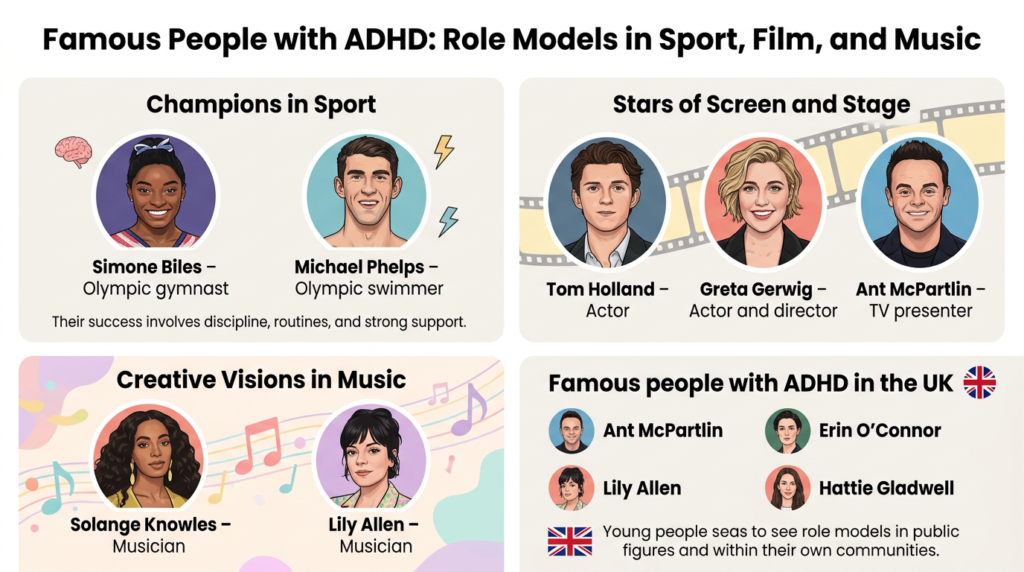
When we look at famous people with ADHD, we see individuals who have learned to work with their neurodiversity in the spotlight.
Champions in Sport
- Simone Biles & Michael Phelps: These athletes highlight that ADHD isn’t a barrier to elite performance.
- The Reality: Their success stems from intense discipline, rigid routines, and a massive support system; not a “superpower” narrative that ignores the hard work required to manage symptoms.
Stars of Screen and Stage
- Tom Holland & Greta Gerwig: Whether it’s the high-energy demands of an action hero or the creative chaos of directing, these ADHD celebrities show how varied the career paths can be.
- Figures like Ant McPartlin have also opened up about their late-stage diagnoses, proving it’s never too late to understand your brain.
Creative Visions in Music
- Solange Knowles & Lily Allen: These artists demonstrate how the ADHD brain can excel in the creative arts. For college students with ADHD, seeing these icons shine in the industry provides hope that their own unique perspectives are valuable.
Famous people with ADHD in the UK
You don’t have to look toward Hollywood to find famous people with ADHD UK. From BBC presenters to Olympic athletes, many British public figures are vocal about their neurodivergence.
In the UK, we see a growing list of celebrities with ADHD, including female celebrities with ADHD like Hattie Gladwell or Erin O’Connor, who help challenge the outdated stereotype that ADHD only affects young boys. However, it is important to remember that role models aren’t always on TV; they can be the older student who moved on to university, a supportive teacher, or a leader in your local community.
If learning about these stories makes you wonder whether ADHD might be part of your own journey, you can explore this in a calm, structured way through our ADHD assessments. Whether you’re looking for an ADHD assessment for adults, seeking support for a child through an ADHD assessment for kids, or prefer a more personalised approach with an in-person ADHD assessment, our process is designed to provide clarity, guidance, and confident next steps.
Why role models matter for young people with ADHD?
Seeing famous people with ADHD in the media does more than just entertain; it challenges the misconception that ADHD only leads to “trouble” at school or work.
- Reframing Strengths: It shows that qualities like high energy, creativity, and the ability to hyperfocus can be incredible assets when the right support is in place.
- Visualising the Future: These stories help young people imagine a future where they aren’t defined by their struggles, reducing the shame of needing extra help or accommodations.
What these stories do (and do not) mean
It is important to stay grounded: People with ADHD still face daily hurdles with organisation, focus, and mental health. Fame does not “cure” ADHD, but it does show what is possible with self-awareness.
Key takeaways for young people with ADHD:
- It is perfectly okay to need tools, medication, or coaching.
- Your specific interests are where your strengths likely live.
- ADHD is a significant part of your journey, but it is not the whole story of who you are.
Conclusion
Seeing famous people with ADHD and other relatable role models helps young people realise they are part of a vibrant, capable community. These stories prove that with the right structure and self-understanding, many paths, including high-level academics for ADHD in young adults and college students, are wide open.
Frequently Asked Questions
Do all talented or creative people have ADHD?
No. While many ADHD celebrities are creative, creativity exists in all brain types. A diagnosis should always be based on a professional clinical assessment, not just a “vibe” or a personality trait.
Does Emma Watson have ADHD?
There are many reports suggesting she was diagnosed as a child and has used medication to manage symptoms. While she is frequently cited among famous people with ADHD, we should always respect individual privacy and look for confirmed, first-hand accounts when identifying role models.
How does the ADHD assessment process work?
At ADHD Certify, we have simplified the journey into five clear steps to ensure it is as calm and structured as possible:
– Pre-Assessment Screening: Initial digital tools to understand your needs.
– 90-Minute Assessment: A detailed, one-on-one session with a specialist.
– Comprehensive Diagnosis Report: A full professional breakdown of the findings.
– Supporting Letter: Documentation to help you access the right support at school, university, or work.
– Personalised Guidance: Expert advice on next steps and management strategies tailored to you.