
ADHD in Children
ADHD Certify offers private ADHD assessments for children aged 5 and above across the UK, same-week appointments available, no NHS referral needed, and a formal written report your child’s school will recognise.
Most children who struggle to focus, stay organised, or keep up in class aren’t lacking effort. Many are undiagnosed.





Same-Week
Availability
Shared Care
Available
No Referral
Needed
ADHD in Children
Looks Different for Everyone
One can’t sit still. The other can’t seem to start. Neither is being difficult. Both have ADHD, and only one of them is likely to be noticed.
ADHD doesn’t look the same in every child. The noisier presentation gets flagged. The quieter one gets missed. Parents and teachers often spend years searching for an explanation that was there from the beginning.

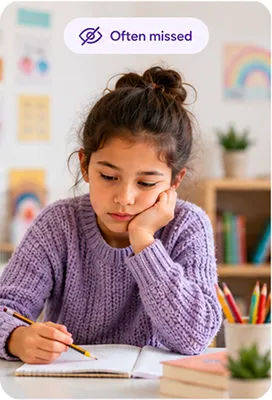
What ADHD Looks Like in Children
Inattentive ADHD in Children
The presentation most often missed. These children are not disruptive, which is exactly why they are overlooked. Their difficulties are internal: sustaining effort, staying on task, holding onto instructions.
Readmore
Signs of Inattentive ADHD in Children
- Rushes through work and makes careless mistakes, despite clearly knowing the material
- Appears not to listen even in a direct one-to-one conversation
- Starts tasks but rarely finishes before something else pulls their attention
- Loses belongings with striking regularity: PE kit, homework, or reading book
- Forgets familiar daily routines even after months of repetition
- Daydreams frequently, often seeming absent in the middle of lessons or conversations
Hyperactive-impulsive ADHD in Children
Readmore
Signs of Hyperactive-impulsive ADHD in Children
- Cannot stay seated: fidgets, squirms, gets up without permission
- Talks excessively, often over adults and peers mid-sentence
- Acts before thinking: blurts out answers, interrupts, takes physical risks
- Finds waiting genuinely difficult whether in a queue, a game or a conversation
- High energy that persists even when they are clearly tired
- Emotional outbursts that seem disproportionate, not defiance but dysregulation
Combined type ADHD in Children
The most commonly diagnosed presentation in children.[2] Most children with ADHD show significant symptoms from both clusters. It is not simply both lists added together. It creates its own pattern: the child who hyperfocuses intensely on something they love but cannot sustain attention on anything else.
Readmore
How does Combined type ADHD presents in Children?

Why So Many Children Are Still Undiagnosed
Children who are disruptive get referred. Children who are quiet, capable, or girls often are not. In UK primary care records, boys are diagnosed at nearly four times the rate of girls[4], not because girls have ADHD less often, but because their presentation is less visible and the referral threshold is higher.[3]
There is also a relative age effect worth knowing about. Children born in July and August are 40% more likely to be diagnosed with ADHD than those born in September[5], simply because normal developmental immaturity in the youngest of the year group gets misread as a disorder. NHS waits compound everything: as of December 2025, over 165,000 children were waiting for an assessment in England, with nearly two thirds waiting more than a year.
Is This Just How Children Are, or Is Something Else Going On?
The clinical distinction comes down to three things:
1
How persistent the difficulties are (consistently present for at least six months, not just during a stressful period).
2
3
How much functional impact they are causing (affecting the child’s learning, friendships or self-esteem in a way that stands out against their peers).
A child who struggles to sit still in assembly but manages well everywhere else probably does not have ADHD. A child who cannot finish tasks, loses belongings daily, struggles to follow instructions across home and school, and is starting to describe themselves as stupid or bad; that pattern is worth taking seriously. The question is not whether the behaviour exists. It is whether it is persistent, pervasive and impairing.
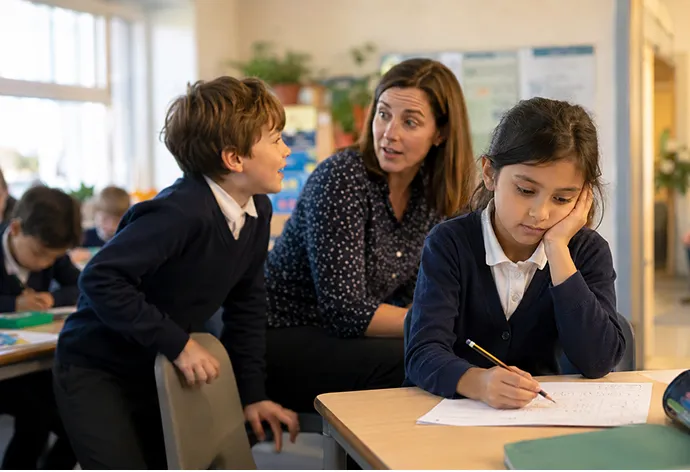
What ADHD Actually Looks Like at Home and at School
At school, the inattentive child’s teacher describes them as capable but unfocused, someone who could do better. At home, getting homework done is a two-hour battle that ends with nothing finished. The child is not refusing. They genuinely cannot start, and they cannot explain why.
For children with the hyperactive-impulsive type, it is the phone calls from school, the notes home, the being moved seats again. There is nothing cruel or calculated in the behaviour. It is a nervous system that runs fast and brakes late, in a setting that requires sustained stillness and waiting.

What ADHD Also Brings for Children
ADHD is not only a set of difficulties. Children with ADHD are often among the most curious, creative, and energetic in their peer group. Many have a capacity for deep, absorbed focus on topics that genuinely captivate them, what researchers call hyperfocus. They may have a quick, original way of thinking, visual-spatial reasoning, and a high tolerance for innovation, which surprises adults.
None of this cancels out the challenges. But understanding both sides matters; for the child’s self-esteem, for how parents and teachers frame the conversation, and for finding the right support. A diagnosis is not a ceiling. It is an explanation that opens the right doors.
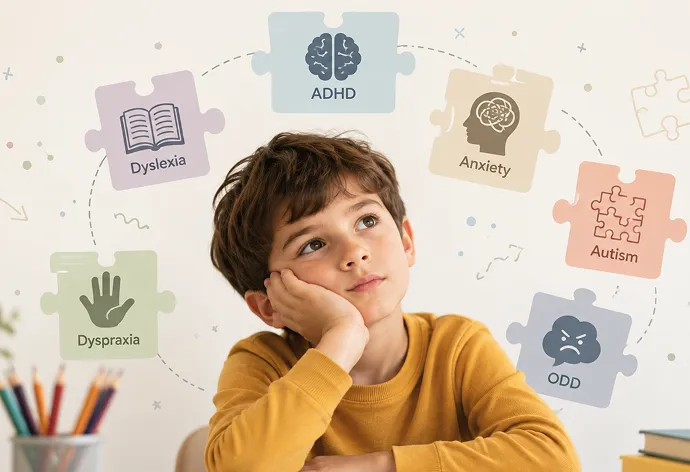
ADHD in Children Rarely Travels Alone
Between 60 and 80% of children with ADHD have at least one co-occurring condition.[7] Dyslexia, dyspraxia, anxiety, autism and ODD are among the most common. This does not mean every child with ADHD has all of these but an assessment that only looks for ADHD may miss part of the picture.
If your child has been assessed for ADHD, it is worth discussing with the assessing clinician whether any co-occurring conditions should also be explored.
Learn more about conditions that commonly occur alongside ADHD in children:
Learn more about conditions that commonly occur alongside ADHD in children:
ADHD Changes as Children Grow
The signs visible in primary school shift when children reach secondary. Hyperactivity tends to reduce; inattention and executive function difficulties often become more exposed as academic demands increase. Understanding the trajectory helps families know what to expect.
ADHD in Toddlers
ADHD in Boys
ADHD in Girls
ADHD in Teenagers
Support for Children with ADHD
An assessment is the starting point, not the end point. Once the picture is clearer, support tends to come from three directions:
Behavioural parent training
For younger children especially, NICE guidelines recommend this before medication is considered. Practical strategies that help parents respond to ADHD-related behaviour more effectively, at home and in routines.
School adjustments
Working with the SENCO on small but meaningful changes including; seating, chunked instructions, movement breaks, flexible deadlines. Most of these do not require a formal diagnosis to begin.
Medication
Where appropriate and agreed with a specialist, ADHD medication can significantly reduce core symptoms and make learning and social life meaningfully easier. It is always monitored carefully and is never the only option.
Find a Child ADHD Assessment Near You
Book a Child ADHD Assessment to get your child the answers they need
A formal assessment does not label your child. It gives them language for their experience, and gives you the tools to actually help.
Frequently Asked Questions
What is the difference between a private and NHS assessment for children?
What age can a child be assessed for ADHD in the UK?
Can ADHD be diagnosed without a school referral?
My child behaves fine at home but struggles at school. Could it still be ADHD?
Will my child need medication if they are diagnosed?
How do I explain an ADHD diagnosis to my child?
References
- NHS England Digital (November 2025). ADHD Management Information. Estimated 744,000 children and young people aged 5 to 24 with ADHD in England. digital.nhs.uk
- American Psychiatric Association (2013). DSM-5. Combined presentation the most common ADHD diagnosis in children.
Readmore
3. Great Ormond Street Hospital NHS (2024). ADHD. Inattentive symptoms harder to recognise; girls underrepresented in referrals. gosh.nhs.uk
4. McKechnie, D. et al. (2023). ADHD diagnoses and prescriptions in UK primary care 2000 to 2018. BJPsych Open. Boys diagnosed at 255 per 10,000 vs 67.7 per 10,000 in girls by 2018.
5. Nicoletti, C. et al. (2024). University of York. Higher ADHD diagnosis in children born in July and August: 40% more likely due to relative age effect within school year.
6. House of Commons Library (2026). FAQ: ADHD Statistics England. As at December 2025, 165,195 children waiting; 65.8% waiting over a year. commonslibrary.parliament.uk
7. Great Ormond Street Hospital NHS (2024). Ibid. 60 to 80% of children with ADHD have at least one co-occurring condition.
8. NICE (2019, updated 2023). ADHD: diagnosis and management. Guideline NG87. Behavioural parent training as first-line for younger children. nice.org.uk