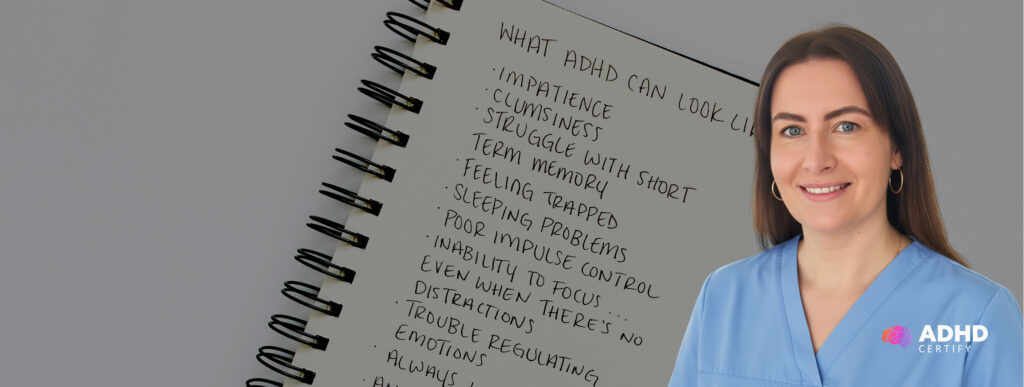
Many women spend years quietly wondering whether their difficulties are simply part of everyday life, a reflection of stress, or signs of anxiety rather than anything neurological. ADHD in women is often subtle, internalised, and masked, meaning it can be lived with for decades before anyone considers it as a possibility.
My own experience of navigating these traits has shaped the compassionate, trauma-aware, and context-sensitive approach we use at ADHD Certify. – Rebecca Wilson, Clinical Director at ADHD Certify.
For many, the question of whether to pursue an ADHD assessment creeps in slowly, often after a long period of coping, compensating, and trying to meet expectations that feel effortless for other people.
ADHD in Adult Women: Early Life and Misunderstood Symptoms
Women typically do not present with the stereotypical behaviours associated with ADHD, which is why so many learn to hide their struggles throughout childhood and adolescence.
They may have been described as bright, well-behaved, quiet, or “a daydreamer”, or praised for maturity and independence while internally grappling with intense mental exhaustion.
Many reflect later in life that they simply thought everyone felt as overwhelmed as they did, or believed they were disorganised, lazy, or too emotional. Others assumed their difficulties were caused by anxiety, trauma, or low confidence rather than lifelong neurodevelopmental patterns.
You can read more about how these patterns are misunderstood in our article on core ADHD traits in women.
Everyday ADHD Symptoms in Women That Are Easy to Miss
The signs that lead women to consider an ADHD assessment are often woven through their entire life story.
Persistent overwhelm, even with small everyday tasks, is a common early clue.
- Something as simple as replying to an email or organising paperwork can feel disproportionately difficult, resulting in avoidance, procrastination, or spending more time thinking about the task than completing it.
- Alongside this, many women describe a lifelong struggle to maintain focus, keep track of conversations, stay organised, or follow tasks through to completion, often losing belongings, missing deadlines, or living with clutter that feels impossible to tackle.
If you’d find it helpful to see these experiences broken down as a structured list, explore our ADHD symptoms in women checklist.
7 Symptoms of High-Functioning ADHD in Women: Quiet Restlessness and Self-Regulation
Many women also engage in subtle forms of physical restlessness that often go unnoticed by others. Rather than the obvious hyperactivity seen in children, this can appear as;
- Constant doodling during meetings
- Tapping a foot under the table
- Fiddling with jewellery
- Picking at sleeves
- Playing with hair
- Adjusting clothing
- Shifting position repeatedly without realising
These behaviours are often dismissed as harmless habits, yet they frequently serve as self-regulation strategies.
They help women maintain focus, manage internal tension, or stay grounded during conversations or tasks that require sustained attention. Because these movements are discreet and socially acceptable, they rarely attract concern, which means their diagnostic significance is often overlooked until much later in life.
ADHD Masking, Perfectionism and Burnout in Women
A great number of women also develop perfectionistic habits in an attempt to manage their executive difficulties. They push themselves to achieve highly, overprepare, and hold impossibly high standards, hiding the significant effort required to stay on top of daily life.
Over time, these coping strategies become exhausting, and many women reach a point of burnout where their familiar ways of coping no longer sustain them. This often coincides with key life transitions such as becoming a parent, taking on new responsibilities at work, returning to education, or entering perimenopause, when hormonal changes can intensify symptoms.
“Winging It”: Undiagnosed ADHD in Women Across Life Stages
Many women describe a lifelong sense of “winging it” keeping life together on the surface while internally feeling disorganised, overwhelmed, or permanently behind.
Even when they have achieved well, it often feels as though everything has been held together through effort rather than ease.
Looking back, the signs were usually there:
- the quiet restlessness
- the difficulty with routines
- the mental clutter
- the constant compensating that became a way of life
These patterns often become impossible to ignore when major transitions occur.
Parenting increases the demands on planning, emotional regulation, and multitasking; perimenopause and menopause can intensify symptoms as hormonal changes reduce the brain’s natural ability to compensate; and even smaller changes a new job, shifting routines, or increased responsibilities can unravel long-standing coping strategies.
For many new mothers, these changes become most obvious during maternity leave with ADHD, when structure falls away and symptoms feel harder to manage.
Rebecca Wilson’s Take on A Compassionate, Trauma-Informed ADHD Assessment for Women
As someone who specialises in working with high-functioning women, and who understands this presentation both professionally and personally, I recognise how easily these patterns can be overlooked.
Many of the women I meet have spent decades masking (related to ADHD masking), compensating, and trying to make sense of why life feels disproportionately difficult.
My own experience of navigating these traits has shaped the compassionate, trauma-aware, and context-sensitive approach we use at ADHD Certify-Rebecca Wilson.
It is the reason our ADHD Certify assessments explore not only the diagnostic criteria but the hidden emotional, hormonal, and executive pressures that so often affect women, ensuring that their stories are heard in full.
What an ADHD Assessment Explores
An ADHD assessment helps to bring clarity to these experiences by exploring both the visible and invisible aspects of a person’s life. It looks at childhood patterns, even when memories are limited, and considers masking behaviours, emotional regulation, trauma history, hormonal influences, and executive functioning.
For women, this means an approach that recognises how adept they may have become at compensating.
A comprehensive assessment can offer a clearer understanding of why life has felt the way it has and provide a pathway towards support and effective strategies.
When to Consider an ADHD Assessment in the UK
If you recognise several of these patterns, or if your difficulties have persisted since childhood and are affecting your daily life, relationships, work, or sense of wellbeing, it may be appropriate to consider an ADHD assessment.
Many women describe feeling an enormous sense of relief when they finally understand the nature of their difficulties, and an assessment can offer validation, direction, and a plan for support.
You are not alone in questioning whether ADHD could be part of your story, and reaching the point of asking the question is often the first step towards understanding yourself more fully.
Book an ADHD assessment UK for women.
Frequently Asked Questions
What are the symptoms of high-functioning ADHD in females?
High-functioning ADHD in females symptoms include internal restlessness, perfectionism, over-preparing, and chronic overwhelm despite outward success.
What do ADHD symptoms in adult women typically look like day to day?
ADHD symptoms in adult women include forgetfulness, time blindness, task overwhelm, emotional sensitivity, and masking that mimics anxiety.
How are the symptoms of ADHD in adult women different from those in men?
ADHD in adult women symptoms are internal (mental restlessness, perfectionism) rather than overt hyperactivity, making them easier to overlook.
What happens during an ADHD assessment for adults?
An ADHD assessment for adults involves clinical interviews, questionnaires, and collateral history to map lifelong attention and executive patterns.
When should I consider a private ADHD assessment instead of waiting for the NHS?
Choose a private ADHD assessment for shorter waits or women-specific expertise when NHS delays impact work, relationships, or wellbeing.
What does ADHD parenting typically feel like?
ADHD parenting feels intense due to added planning, emotional regulation, and multitasking demands, often with guilt despite deep love for children.
How to parent a child with ADHD and autism?
Use structure, visual aids, and self-assessment to support both your ADHD brain and your child’s needs.