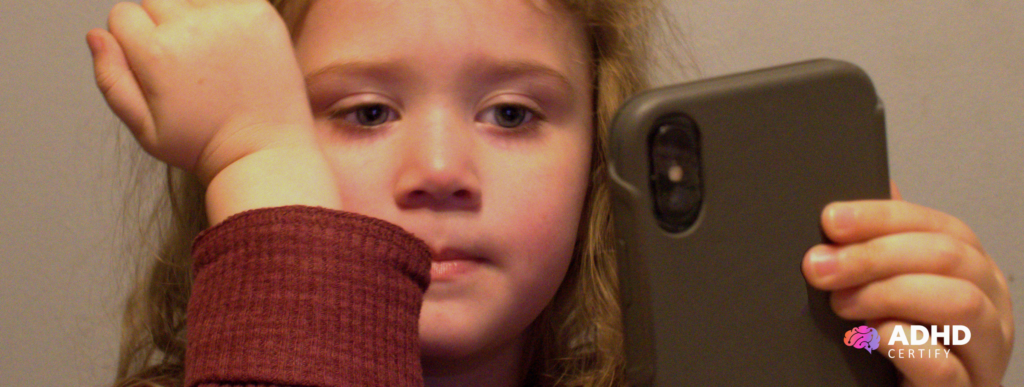
You have asked your child to turn off the tablet more than once, voices rise, and afterwards you wonder whether this is more than enthusiasm. Difficulty stopping can go with ADHD, but one argument, or one long gaming session, does not mean your child is addicted.
Many parents search for ADHD phone addiction at this point, and this guide explains why screens hold children with ADHD so firmly, how to spot real harm, and one calm change to try.
The first step is understanding what keeps pulling your child back.
Key Takeaways:
- Difficulty switching off is common with ADHD, but it is not proof of addiction
- Look at sleep, school and daily life, not hours alone
- Calm, predictable routines are a sensible first step
- Ask for help if sleep, mood or safety are affected
Why screens can be so hard to put down with ADHD
ADHD and phones are a tricky mix. Screens give a child with ADHD what is often hard to find elsewhere: quick feedback, constant novelty and a clear next step.
Games and videos reward effort in seconds, but homework rarely does. Stopping can be hard too, because it means shifting attention and judging how long you have played. For some children, a screen is also a break from school or social pressure.
That is why many kids with ADHD can play for hours yet struggle to start homework. It is not proof of defiance, and it is not proof of ADHD. Screens also bring real benefits, including study, creativity and friendships.
Headlines about ADHD and phone addiction are often louder than the evidence. ADHD symptoms with a higher chance of problematic digital-media use, and the link seems to run both ways. It is stronger for problematic use than for total screen time. ¹ These studies measured symptoms, so they cannot tell you about any one child. Enjoying screens intensely is different from screens repeatedly crowding out everyday life.
Is it addiction, or is stopping simply difficult?
Not necessarily: what families call ADHD phone addiction becomes a concern when screens repeatedly harm sleep, school or wellbeing despite your best efforts.
Look for a pattern over time and across your child’s life:
- Sleep is repeatedly pushed aside
- School, meals or self-care are affected
- Other valued activities keep being lost
- Control is repeatedly lost despite support and clear harm
Calling a child “phone addicted” may feel accurate after a bad evening, but it is a label, not a diagnosis. The formal diagnosis is gaming disorder. The World Health Organisation describes impaired control over gaming, increasing priority over other activities, and continuing despite harm, with significant impairment normally evident for at least 12 months. ² It affects only a small proportion of people who game. ² It is not a checklist for phones, and it is not a reason to wait a year before asking for help. You do not need to settle on a label before making home life easier.
A calmer plan for screen time at home
There is no quick answer to how to stop phone addiction in a child, but there is a calm order to work in. None of the guidance used for this article sets an ADHD-specific allowance, so start with your own child, not a number.
- Observe. For a few days, note what your child uses, when, what happened before and after, how they slept and what they value about it. This will be a clearer picture, not a diagnostic diary or spying.
- Agree on one boundary. At a calm moment, agree on one clear end point for a session. Younger children can use a visual plan, and teenagers do better when they help set it. You still hold the boundary.
- Ease the transition. Agree stopping points before the game starts, give a warning, help your child save progress or tell friends, and make the next activity visible. For multiplayer games, set the session boundary beforehand rather than negotiating “one more round”.
- Replace what the screen provides. If it is decompression after school, offer a low-demand shared activity or movement your child likes. If it is friendship, plan a safe time with peers. Keep technology used for school, access needs and meaningful friendships.
- Protect sleep, then review. Agree where devices charge overnight, check notification and autoplay settings, and talk openly about any parental controls. Our guide to sleep difficulties in children with ADHD may help. After a week, review sleep, conflict and school, not perfect compliance.
A suggested script, not a clinical protocol: “I can see stopping is hard. We agreed this is the last round. Let’s save it, then choose what comes next.”
Boundaries remain the adult’s responsibility, even when your child helps set them. If you have ADHD yourself, choose one visible rule rather than an elaborate chart. NICE notes that parents with ADHD may need extra organisational support, and that being offered parent training does not imply bad parenting. ³
If switching off still ends in a meltdown
Many parents reach this point exhausted. A meltdown does not make your child manipulative, and it does not mean you have failed. During escalation, prioritise safety, lower demands and keep words few. Do not debate the plan mid-crisis, and never grab a device from a distressed child or use physical restraint. Come back to it when everyone is calm.
Repair the conversation without dropping every boundary. Ask whether anxiety, bullying, school pressure, tiredness or an unmet need is feeding the reaction, rather than assuming ADHD explains everything. Recurring severe reactions deserve support, and dangerous aggression should never be treated as normal.
Where to get help: GP, ADHD assessment and NHS gaming support
Start with your GP, or your child’s ADHD clinician if they have one, if sleep, mood or daily functioning stay affected. Talk to the teacher or SENCO if school is struggling. If your child is in immediate danger, call 999.
“Has my child got ADHD?” cannot be answered from screen behaviour alone. NICE advises that ADHD should only be diagnosed by a suitably qualified specialist, using evidence from more than one setting. ³
If those difficulties go well beyond screens, you can book an ADHD assessment for children for a detailed clinical report on how ADHD affects your child’s daily life, which schools and other services can use.
If gaming is causing significant harm, the NHS National Centre for Gaming Disorders accepts referrals for young people in England aged 13 and over, and supports parents and carers of 13 to 16-year-olds, with the young person’s consent. ⁴ It is not a general phone-addiction service. Younger children, and families who cannot use that service, can still start with the GP or local children’s services.
If screens are hard for you too, our guide to ADHD and technology use in adults covers the adult side of the same family challenge. The aim is safer routines, more connection and less disruption, not zero screens.
References
[1] Thorell, L.B. et al. (2024) Longitudinal associations between digital media use and ADHD symptoms in children and adolescents: a systematic literature review. European Child & Adolescent Psychiatry, 33(8), pp. 2503-2526. https://doi.org/10.1007/s00787-022-02130-3
[2] World Health Organization (2020) Addictive behaviours: gaming disorder. Questions and answers, 22 October 2020. Available at: https://www.who.int/news-room/questions-and-answers/item/addictive-behaviours-gaming-disorder
[3] National Institute for Health and Care Excellence (2018) Attention deficit hyperactivity disorder: diagnosis and management. NICE guideline NG87. Available at: https://www.nice.org.uk/guidance/ng87/chapter/recommendations
[4] Central and North West London NHS Foundation Trust (no date) The National Centre for Gaming Disorders. Available at: https://www.cnwl.nhs.uk/national-centre-gaming-disorders