
Similarities, Differences, and Overlapping Traits
ADHD and autism are two of the most commonly discussed neurodevelopmental conditions, and they are also two of the most commonly confused. If you’re trying to understand whether you or someone you know has one, the other, or both, this article gives you a clear, evidence-based answer without oversimplifying the picture.
Disclaimer: The information in this article is for general guidance only and does not constitute medical advice. Always consult a qualified clinician about your own or your child’s health and do not make changes to treatment based solely on what you read here.
Key Takeaways:
- ADHD and autism are separate conditions with different diagnostic criteria
- ADHD is not a form of autism and is not on the autism spectrum
- Both conditions can and frequently do occur together in the same person
- Overlapping traits make diagnosis more complex and sometimes delayed
- A proper assessment considers both conditions rather than stopping at the first label found
Are ADHD and Autism the Same Thing?
No. ADHD and autism are distinct neurodevelopmental conditions. ADHD is not a form of autism, and it is not on the autism spectrum. Both are recognised in the DSM-5 and ICD-11 as separate diagnoses with separate diagnostic criteria, and since 2013 it has been possible to diagnose both in the same person.¹
That said, ADHD and autism do overlap in meaningful ways. Both are neurodevelopmental, both have genetic underpinnings, and both can produce similar-looking difficulties in daily life. The overlap is real and increasingly well-documented. But overlap does not mean they are the same condition, and it does not mean that one is a milder or more severe version of the other.
- Is ADHD on the autism spectrum?
No. The autism spectrum describes the range of presentations within autism, from less to more support needs. ADHD sits entirely outside that spectrum as its own distinct condition.
- Is ADHD a form of autism?
Again, no. The two share features and can co-occur, but they have different neurological profiles, different diagnostic criteria, and often respond differently to treatment.
Similarities Between ADHD and Autism
Both conditions can produce difficulties that look similar on the surface, which is one reason they are so often confused.
Shared features include executive function difficulties such as problems with planning, organising, and managing time. Both can involve emotional dysregulation, where emotional responses feel intense or hard to manage. Sensory sensitivities are common in autism and also reported by many people with ADHD. Social challenges can arise in both, though for different underlying reasons. And both conditions are frequently missed in girls and women, leading to late or missed diagnoses.¹
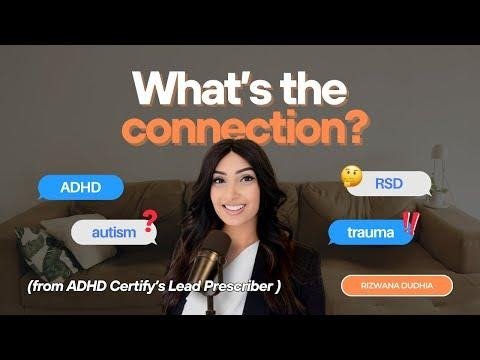
Rizwana Dudhia, Lead Prescriber and Child ADHD Specialist at ADHD Certify, has over a decade of specialist mental health experience with a particular focus on distinguishing ADHD from autism and learning disabilities. Watch Rizwana discuss ADHD, autism, RSD, and trauma and how these conditions intersect in real clinical practice.
The overlapping traits of ADHJD and Autism are clinically significant because they can lead to one condition being diagnosed while the other is missed. Someone with both ADHD and autism may receive only one diagnosis, particularly if the clinician is not experienced with how both present.
If overlapping traits have led to a missed or wrong diagnosis, our article on ADHD misdiagnosis covers the most common routes and what to do about it.
Differences Between ADHD and Autism
While the conditions share features, their core characteristics differ in important ways.
ADHD is primarily characterised by difficulties with attention regulation, impulse control, and activity level. The attention in ADHD is inconsistent and interest-driven. Executive function difficulties are central. Emotional dysregulation is common. But ADHD does not involve the specific social communication differences or the preference for sameness and routine that define autism.
Autism is primarily characterised by differences in social communication, a preference for predictability and routine, restricted or intensely focused interests, and sensory processing differences. The social difficulties in autism arise from a fundamentally different way of processing social information, not from distraction or impulsivity. Repetitive behaviours and patterns are defining features of autism but are not diagnostic criteria for ADHD.¹
The most practically useful distinction: in ADHD, attention regulation is the primary difficulty. In autism, social communication and the need for sameness are primary. Both may produce what looks like social difficulty or inattention from the outside, but the mechanism is different.
ADHD and Autism Diagnosis: When Both Are Present
ADHD and autism diagnosis becomes more complex when both conditions are present. Research suggests that around 33 to 39% of people with autism also have ADHD, and a significant proportion of people with ADHD show autistic traits.² The combination can make each condition harder to identify because the presentations can obscure each other.
This is why ADHD and autism diagnosis should not stop at the first label that fits. A person with ADHD and social anxiety may be diagnosed with autism only, missing the ADHD entirely. A person with autism who has strong interest-driven focus may appear not to have ADHD, even when attention regulation difficulties are present elsewhere.
The term AuDHD is sometimes used in neurodivergent communities to describe people with both diagnoses. It is not a clinical term, but it reflects a real and increasingly recognised experience. What matters clinically is that both conditions are identified and that support is appropriate for the full picture.
ADHD and autism covers what co-occurrence looks like in practice and how assessment works when both conditions may be present.
When to Seek an Assessment
If you recognise traits of one or both conditions in yourself or your child, and those traits are affecting daily life, work, education, or relationships, a formal assessment is the right next step. If you have previously been assessed for one condition but feel something has been missed, it is reasonable to request a review.
Our adult ADHD assessment provides a detailed clinical report covering how ADHD affects your daily functioning, with specific attention to presentations that may overlap with or be confused with other conditions.
If you recognise traits of both conditions and you’re unsure whether to pursue an ADHD assessment, an autism assessment, or both, you don’t have to choose upfront. Our combined ADHD and autism assessment is designed for exactly this situation. It produces a single unified report covering both conditions, which is accepted by GPs, employers, universities, and Access to Work.
Frequently Asked Questions
Can you have both ADHD and autism?
Yes. Since 2013 it has been possible to receive both diagnoses. Research suggests around 33 to 39% of people with autism also have ADHD. When both are present, each can make the other harder to identify, which is why thorough assessment by an experienced clinician matters.
Why are ADHD and autism so often confused?
Both conditions produce overlapping traits including executive function difficulties, sensory sensitivities, and social challenges. They can look similar on the surface, especially when a clinician is not experienced with dual presentations. In women and girls, both conditions are frequently missed, making confusion more likely.
References
[1] Solano, J.L. et al. (2024) Unraveling the spectrum: overlap, distinctions, and nuances of ADHD and ASD in children. Frontiers in Psychiatry, 15, Article 1387179. https://doi.org/10.3389/fpsyt.2024.1387179
[2] American Psychiatric Association (2024) When autism and ADHD occur together. Available at: https://www.psychiatry.org/news-room/apa-blogs/when-autism-and-adhd-occur-together